Requirement metamodel
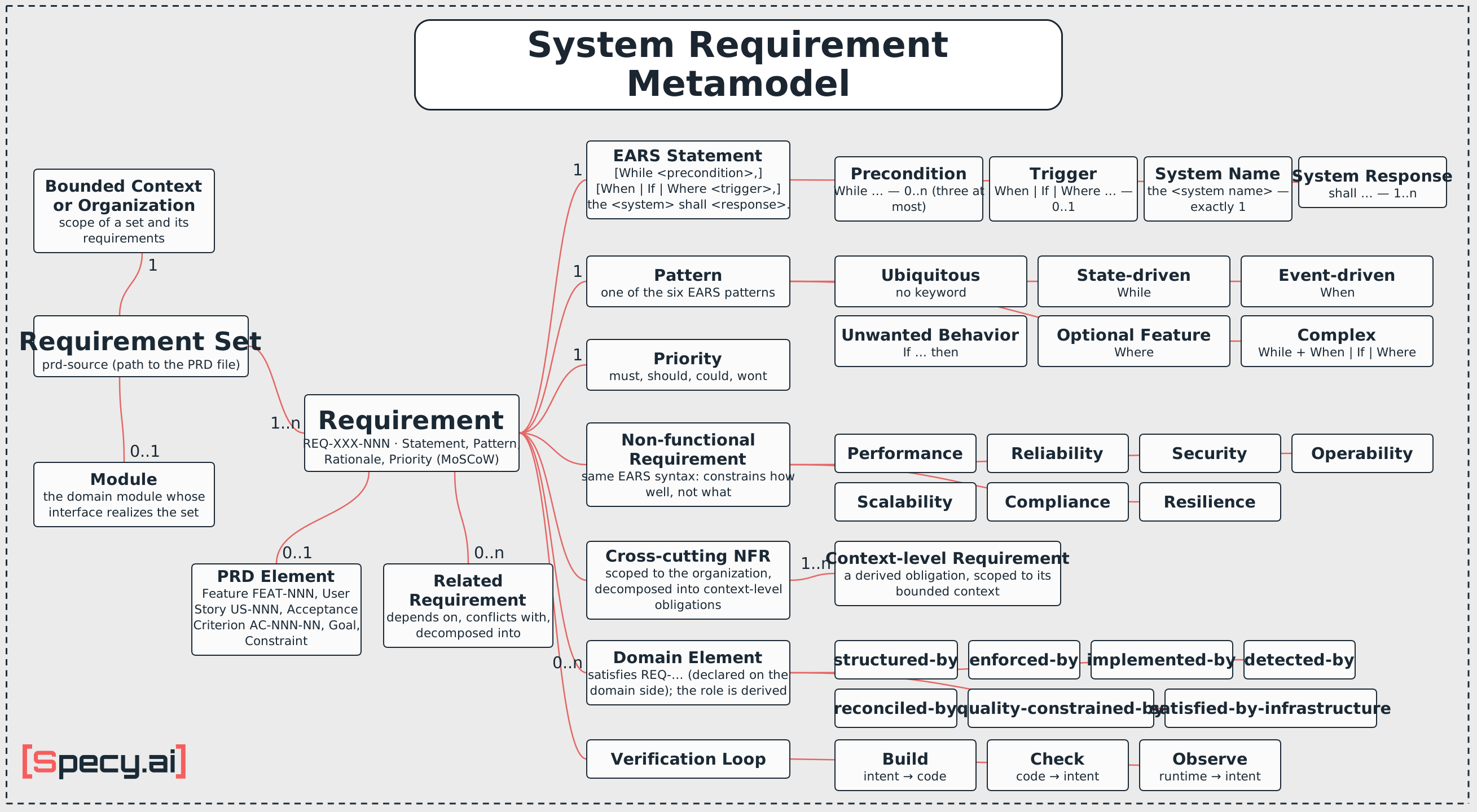
This file defines a requirement layer that sits above the domain model metamodel (see DOMAIN-METAMODEL.md). Its purpose is to capture what the system shall do using the EARS syntax.
System requirements are the parent of domain models. One set of system requirements may be realized by multiple domain models (e.g. different implementations, different technology stacks, or different bounded contexts). The traceability direction is bottom-up: domain model elements reference the requirement identifiers they satisfy via the satisfies attribute defined in DOMAIN-METAMODEL.md. System requirements do not reference domain model elements — they declare obligations without prescribing realization.
Convention
Every concept in this metamodel carries a name, a description, and a metadata map (a set of arbitrary key/value pairs). These attributes are implicit and not repeated in each definition below.
This metamodel is downstream of PRODUCT-REQ-METAMODEL.md and upstream of DOMAIN-METAMODEL.md. It speaks the language of system obligations — what the system shall do — not the language of product management (personas, goals) or domain modeling (entities, commands, events).
When the product requirements that originated the system requirements are stored in a file, the requirement set MUST declare a prd-source attribute containing the relative path to that file. This makes the provenance chain file-resolvable: an agent or tool can follow prd-source to read the PRD, then match each requirement’s source field to the corresponding PRD element (feature, user story, acceptance criterion, constraint, or goal). Combined with the requirements-source attribute on the domain model (defined in DOMAIN-METAMODEL.md), this creates a complete file-level traceability chain from product requirements through system requirements to the domain model.
EARS — Easy Approach to Requirements Syntax
EARS was developed by Alistair Mavin, Philip Wilkinson, Adrian Harwood, and Mark Novak at Rolls-Royce PLC (published at IEEE RE ‘09, pp. 317–322). It provides a lightweight, structured syntax for writing natural-language requirements that are unambiguous, testable, and complete.
EARS addresses eight deficiencies of unconstrained natural language: ambiguity, vagueness, complexity, omission, duplication, wordiness, inappropriate implementation, and untestability. It achieves this through a small set of keywords (While, When, If, Where) that make preconditions, triggers, and error handling explicit.
The EARS ruleset
Every EARS requirement conforms to this structure:
[While <precondition(s)>,] [When|If|Where <trigger or condition>,]
the <system name> shall <system response(s)>.
Constraints on the structure:
- Zero or many preconditions (optional
Whileclauses). Recommended limit: three. Beyond three, decompose into separate requirements or use a decision table. - Zero or one trigger (optional
When,If, orWhereclause). - Exactly one system name (the entity, aggregate, service, or bounded context being specified).
- One or many system responses (the required behavior, stated with
shall). - Clauses always appear in temporal order: preconditions → trigger → system name → response.
- Each requirement is a single sentence.
EARS patterns
Six patterns cover the full spectrum of requirement types. Each pattern is identified by its keyword(s).
Ubiquitous
An always-active, unconditional requirement. No keyword.
The <system name> shall <system response>.
Example: “The system shall reject order lines with a quantity less than one.”
Use for: fundamental system properties, structural constraints, invariants that hold regardless of state or event.
State-driven (While)
A requirement active only while a specified state or condition holds.
While <system state>, the <system name> shall <system response>.
Example: “While the order is in draft, the system shall allow line additions.”
Use for: mode-dependent behavior, state-scoped invariants, preconditions that apply only in certain lifecycle phases.
Event-driven (When)
A requirement triggered by a specific event or action.
When <trigger event>, the <system name> shall <system response>.
Example: “When payment is confirmed, the system shall transition the order to confirmed status and emit an OrderConfirmed event.”
Use for: commands, operations, event-driven state transitions, reactive behavior.
Unwanted behavior (If-Then)
A requirement handling an undesired situation, error, or failure.
If <unwanted condition or trigger>, then the <system name> shall <system response>.
Example: “If the ordered product is out of stock, then the system shall reject the order and notify the customer.”
Use for: error handling, fault tolerance, compensating actions, violation detection. This pattern makes omissions in error handling visible — the most common and costly category of missing requirements.
Optional feature (Where)
A requirement applying only to system variants that include a specific capability.
Where <feature is included>, the <system name> shall <system response>.
Example: “Where express shipping is available, the system shall offer same-day delivery for orders placed before noon.”
Use for: product-line features, configurable capabilities, optional modules.
Complex
A requirement combining multiple EARS keywords for richer behavior. Keywords appear in strict temporal order: While → When/If/Where → system → response.
While <precondition(s)>, When <trigger>, the <system name> shall <system response>.
While <precondition(s)>, If <unwanted trigger>, then the <system name> shall <system response>.
Where <feature>, When <trigger>, the <system name> shall <system response>.
Example: “While the customer has an active credit account, when an order is placed, if the order total exceeds the remaining credit limit, then the system shall hold the order for manual approval.”
Use for: guarded triggers, conditional error handling, feature-scoped events.
Requirement
A requirement is a named EARS statement that declares a system obligation.
A requirement has:
- id: a unique, stable identifier (e.g.,
REQ-ORD-001). The prefix anchors the requirement to a bounded context or domain area. The identifier never changes, even if the statement is revised. - statement: the full EARS sentence, following one of the six patterns above.
- pattern: one of
ubiquitous,state-driven,event-driven,unwanted,optional,complex. - rationale: why this requirement exists — the business justification. Equivalent to the
::operator on domain constructs. The rationale is not itself verifiable; it explains why the verifiable obligation exists. - priority: a domain-expert-assigned weight using MoSCoW classification:
must— non-negotiable. The system is unacceptable without it.should— important but not blocking. The system is degraded without it.could— desirable. Included if effort permits.wont— explicitly excluded from the current scope (documented to prevent scope creep).
Relations:
- 1..1 “scoped to” relation with bounded context or organization (functional requirements scope to a BC; cross-cutting NFRs scope to the organization. When the requirement belongs to a set, this relation is inherited from the set’s scope and is not declared on the requirement itself)
- 0..1 “sourced from” relation with external reference (PRD element, business goal, regulatory clause — the product decision or business context that originated this requirement. When the PRD element carries a stable identifier —
FEAT-NNN,US-NNN,AC-NNN-NN, see PRODUCT-REQ-METAMODEL.md — the reference is that ID, an exact rename-safe match; elements without IDs are referenced by name. This is a provenance marker: it answers who asked for this and why, enabling impact analysis from product strategy change to affected requirements.) - 0..n “depends on” relation with other requirements (logical prerequisite: requirement B cannot be satisfied unless requirement A is satisfied first)
- 0..n “conflicts with” relation with other requirements (explicit tension: both requirements cannot be fully satisfied simultaneously — the model must document the resolution strategy)
- 0..n “decomposed into” relation with other requirements (an organization-level requirement creates derived obligations on context-level requirements that collectively satisfy it)
- 0..1 “belongs to” relation with a requirement set
Requirement Set
A requirement set groups related requirements into a coherent unit — typically aligned with a business capability, a use case cluster, or a module boundary.
A requirement set has:
- prd-source (optional): the relative path to the product requirements file from which this set’s requirements were derived. When present, the
sourcefield on individual requirements references elements inside this file. Multipleprd-sourcedeclarations are allowed when product requirements span several files.
Relations:
- 1..n “contains” relation with requirements
- 0..1 “maps to” relation with a module (the module whose interface realizes this set; organization-scoped sets have no module mapping)
- 1..1 “scoped to” relation with a bounded context or the organization (mirroring Requirement’s scoping: a functional set scopes to a bounded context; a set of cross-cutting NFRs scopes to the organization)
Scope coherence: a requirement contained in a set inherits the set’s scope — in the DSL, scoped-to is written once on the set, never on individual requirements. A requirement declares its own scope directly only when it belongs to no set. Consequently an organization-scoped requirement lives in an organization-scoped set (or in none), and mixing organization-scoped and context-scoped requirements in one set is impossible by construction.
Traceability
System requirements are the parent layer. Domain models (defined in DOMAIN-METAMODEL.md) reference requirements via the satisfies attribute on each domain element. This bottom-up traceability enables two analyses that can be performed by traversing the satisfies lists in the domain model:
- Coverage analysis — Which requirements have no domain element satisfying them? A requirement whose ID appears in no
satisfieslist is unsatisfied — either a modeling gap (the domain model is incomplete) or a premature requirement (written before the domain was understood enough to model it). - Orphan analysis — Which domain elements satisfy no requirement? A domain element with an empty
satisfieslist is an orphan — either over-engineering or a missing requirement. Orphan analysis is especially valuable during legacy extraction, where code contains implicit requirements that were never written down.
These analyses are defined and executed from the domain model side (see DOMAIN-METAMODEL.md, “Requirement Traceability” section). The system requirement layer does not maintain links to domain elements — it only declares obligations.
Additionally, at the requirement level:
- Conflict detection — Requirements linked by
conflicts-withthat cannot both be fully satisfied create an unresolved tension. The resolution strategy must be documented (typically through priority, a mediating reaction, or an agreement).
Satisfaction roles
A satisfies reference states that a domain element satisfies a requirement. The satisfaction role classifies how it does so. There are seven roles:
| Role | How the requirement is satisfied | Typical satisfying elements |
|---|---|---|
structured-by |
By the shape of the model — the obligation is met because the structure makes it so | Entity, Aggregate, Value Type, field |
enforced-by |
By a rule the model actively upholds — violations are rejected, compensated, or alerted | Invariant, Precondition, compensating Reaction |
implemented-by |
By behavior — the element performs the obliged system response | Operation, Command, Event, Domain Service |
detected-by |
By making an unwanted condition observable — the failure path of an unwanted (If-Then) requirement |
Error Event, detecting Reaction |
reconciled-by |
By coordinated eventual consistency — the obligation spans aggregates and is maintained, not enforced | Agreement, Reconciliation, Escalation Chain |
quality-constrained-by |
By a domain element whose declared quality attributes meet an NFR’s bar | Infrastructure Service, Operation (latency, throughput) |
satisfied-by-infrastructure |
Below the domain layer — deployment, networking, or operational tooling meets the obligation; no domain element carries a satisfies reference (see the honest-boundary rule under cross-cutting NFRs) |
— |
The role is derived, not recorded. The satisfies attribute remains a flat list of requirement identifiers — there is no role slot on it, by design. The role follows mechanically from the kind of domain element that carries the reference: an entity satisfying a requirement is satisfying it structurally, an invariant is enforcing it, an error event is detecting it. Recording the role alongside the identifier would duplicate information the model already states and let the two drift apart. Tools performing coverage analysis may compute and report the role; modelers never write it.
The roles also connect to the EARS patterns: ubiquitous requirements are typically structured-by or enforced-by; event-driven requirements are implemented-by; unwanted requirements are detected-by (and often additionally enforced-by through the compensating path); NFRs are quality-constrained-by or satisfied-by-infrastructure. The mapping from domain concept types to roles is tabulated on the domain side (DOMAIN-METAMODEL.md, “Traceability by concept type”).
Integration with verification loops
The requirement layer plugs into Specy’s three verification loops:
| Loop | Role of Requirements |
|---|---|
| Build (intent → code) | Requirements are the input specification. The builder reads requirements and produces a domain model whose elements declare satisfies references back to the requirement IDs. Every must and should requirement should be traceable to at least one domain element. |
| Check (code → intent) | The checker traverses satisfies lists in the domain model and verifies that every referenced requirement ID is covered. A requirement ID that appears in no satisfies list is a checker failure — a gap between intent and model. |
| Observe (runtime → intent) | Requirements with event-driven or unwanted patterns are observable at runtime. The observer traces event flows and verifies that the behaviors declared in requirements actually occur. Missing events or unhandled error conditions signal drift between intent and behavior. |
The requirement layer does not replace the domain model — it governs it. The domain model remains the structural and behavioral specification. Requirements declare why each element must exist and what obligation it fulfills.
Non-functional requirements
Non-functional requirements (NFRs) use the same EARS syntax as functional requirements. There is no separate grammar — an NFR is a requirement. What distinguishes an NFR is that it constrains how well the system performs rather than what it does. EARS patterns are expressive enough: a latency budget is an event-driven requirement, an availability SLA is ubiquitous, an encryption obligation is ubiquitous, a degraded-mode behavior is a state-driven requirement.
The metric itself lives in the EARS statement. Domain model elements that realize NFRs reference them via the satisfies attribute, just like functional requirements.
NFR categories and their domain anchors
Not all NFRs are equal. Some trace directly to domain model elements; others are cross-cutting and require broader scoping. The table below classifies NFR categories by where they anchor in the metamodel.
| Category | What it constrains | Typical domain anchor | Scoping |
|---|---|---|---|
| Performance | How fast an operation responds or how much throughput it sustains | Operation, Domain Service, Infrastructure Service | Bounded Context |
| Reliability | How often the system is available, how it recovers from failure, how much data loss is tolerable | Entity (durability), Operation (retry/fallback), Infrastructure Service (redundancy) | Bounded Context or Organization |
| Security | How data is protected, who can access what, how secrets are handled | Entity (data classification), Operation (authorization), Value Type (encryption), Infrastructure Service (auth provider) | Bounded Context or Organization |
| Operability | How the system is monitored, deployed, debugged, and maintained | Operation (observability), Event (audit trail), Infrastructure Service (logging, alerting) | Bounded Context or Organization |
| Scalability | How the system handles growing load without degradation | Operation (throughput ceiling), Entity (partitioning), Infrastructure Service (elastic capacity) | Organization |
| Compliance | How the system meets regulatory, legal, or contractual obligations | Entity (data retention, deletion), Operation (audit), Value Type (PII classification) | Organization |
| Resilience | How the system behaves when parts fail — degraded modes, circuit breaking, bulkheading | Operation (fallback behavior), Infrastructure Service (circuit breaker), Reaction (compensating action) | Bounded Context |
NFR discovery heuristic
When writing requirements, the modeler should systematically ask these questions for each scope level. The questions are designed to surface NFRs that are frequently omitted.
Per operation
- Latency: Does this operation have a response time budget? What is the p95/p99 target?
- Throughput: How many invocations per second must this operation sustain at peak?
- Idempotency: If this operation is retried, does it produce the same result? Is that a requirement or just a nice-to-have?
- Timeout: What happens if this operation does not complete? Is there a deadline?
- Authorization: Who is allowed to invoke this operation? Is there a role or permission model?
- Audit: Must this operation’s invocation be logged for compliance? Who needs the audit trail?
Per entity
- Data classification: Does this entity hold personal data (PII), financial data, health data? What regulatory regime applies?
- Retention: How long must this entity’s data be kept? When must it be deleted?
- Encryption: Must this entity’s data be encrypted at rest? In transit?
- Backup and recovery: What is the recovery point objective (RPO) — how much data loss is tolerable? What is the recovery time objective (RTO) — how fast must the data be restored?
- Partitioning: Does this entity need geographic or tenant-based partitioning for data residency?
Per infrastructure service
- Availability: What is the SLA of the external system this service wraps? What happens when it’s down?
- Circuit breaking: Should the system stop calling a failing dependency after N failures?
- Fallback: Is there a degraded mode when this service is unavailable? What data is stale-acceptable?
- Rate limiting: Does the external system impose rate limits? How does the system handle throttling?
Per bounded context
- Availability SLA: What uptime percentage must this context guarantee to its consumers?
- Deployment independence: Can this context be deployed without coordinating with other contexts?
- Observability: What metrics, logs, and traces must this context expose?
- Incident response: What is the severity classification? What is the escalation path?
Per organization (cross-cutting)
- Regulatory compliance: GDPR, PCI-DSS, HIPAA, SOC2 — which frameworks apply?
- Data sovereignty: Must data stay within specific geographic boundaries?
- Disaster recovery: What is the organization-wide RPO/RTO?
- Security baseline: Are there mandatory authentication, encryption, or network segmentation standards?
- Accessibility: Must the system meet WCAG or other accessibility standards?
Cross-cutting NFRs — scoping beyond a single bounded context
Some NFRs cannot be meaningfully scoped to a single bounded context. “99.9% availability” is an organizational commitment. “PCI-DSS compliance” spans every context that touches payment card data. “GDPR right to erasure” requires coordinated deletion across multiple BCs.
These cross-cutting NFRs are handled as follows:
Scoping
The scoped-to relation — on a requirement and on the requirement set that contains it — accepts either a bounded context or the organization. Cross-cutting NFRs are grouped into a requirement set scoped to the organization, and each requirement in the set inherits that scope.
requirements "Platform Reliability" scoped-to RideNowOrganization {

  REQ-NFR-001 "Platform availability" : ubiquitous
    :: "Contractual SLA with riders and drivers — breach triggers penalties"
    "The RideNow platform shall maintain 99.9% availability measured
     monthly across all rider-facing and driver-facing services."
    priority must
}
Decomposition into context-level obligations
A cross-cutting NFR at the organization level creates derived obligations on each bounded context it affects. The derivation is explicit: the organization-level requirement depends-on (or is-parent-of) context-level requirements that collectively satisfy it.
  // inside the organization-scoped set "Platform Reliability"
  REQ-NFR-001 "Platform availability" : ubiquitous
    priority must
    decomposed-into {
      REQ-RIDE-NFR-001   // Ride Management context availability
      REQ-PAY-NFR-001    // Payment context availability
      REQ-GEO-NFR-001    // Geolocation context availability
      REQ-DRV-NFR-001    // Driver Management context availability
      REQ-RDR-NFR-001    // Rider Management context availability
    }
Each derived context-level requirement is a regular EARS requirement scoped to its BC. Domain model elements within each BC reference the derived requirement via satisfies. The decomposition makes it explicit that the organizational SLA is a collective responsibility — not owned by any single team.
Some cross-cutting NFRs may not be realizable by domain model elements at all — they are satisfied by deployment, networking, or operational tooling below the domain layer. Domain model elements that cannot satisfy such a requirement simply do not include its ID in their satisfies list. The requirement is still tracked, still has an owner, still has a priority — the absence of a satisfies reference in the domain model is an honest boundary, not a gap.
Cross-cutting NFR and the verification loops
| Loop | Role of Cross-Cutting NFRs |
|---|---|
| Build | Derived context-level requirements guide infrastructure choices (database encryption, circuit breaker configuration, monitoring setup). The builder reads the requirement and knows what quality bar to meet. |
| Check | The checker verifies that each derived context-level requirement is either referenced by a domain element’s satisfies list or acknowledged as infrastructure-only. Requirements with no domain-level satisfies reference and no infrastructure acknowledgment are gaps. |
| Observe | Cross-cutting NFRs are the primary targets of the Observe loop. Availability SLAs are monitored via uptime dashboards. Latency budgets are tracked via distributed tracing. Compliance obligations are verified via periodic audits. The Observe loop detects drift between declared NFRs and actual system behavior. |